
What Makes Diamondiyne an Interesting Scientific Discovery?
Carbon is one of the most important elements in nature. It forms the foundation of many substances found in living organisms and is also used in materials ranging from pencils to advanced electronics. Although diamond and graphite are its best-known forms, carbon atoms can arrange themselves into many different structures.
Scientists have now reported the synthesis of diamondiyne, a porous, three-dimensional carbon material that researchers had proposed decades ago. The discovery offers a new way to study how carbon atoms can be connected to form unusual structures.
According to The Times of India's report on diamondiyne, the researchers produced films containing crystalline regions consistent with this long-sought carbon architecture.
The achievement is significant for materials science, although further research will be needed before any practical applications can be confirmed.
What Is Diamondiyne?
To understand diamondiyne, it helps to look at the different ways carbon atoms bond together.
In diamond, carbon atoms form a strong, three-dimensional network. In graphite, carbon atoms are arranged in layers. Other forms, including graphene and carbon nanotubes, demonstrate how changing the arrangement of the same element can produce very different material structures.
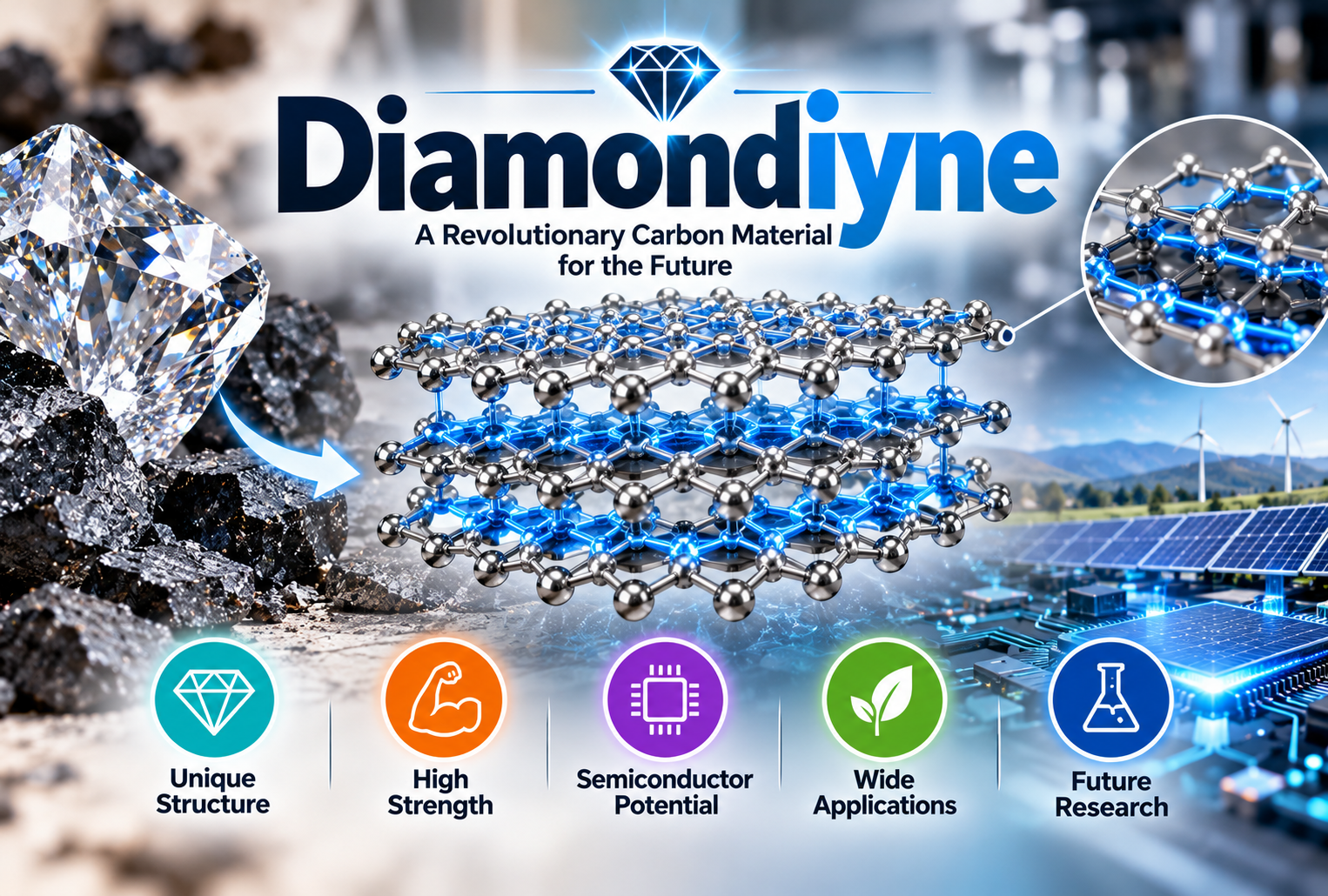
Diamondiyne has a diamond-like framework, but it incorporates carbon-carbon triple bonds into the network. These bonds help expand the structure and create a more open arrangement compared with ordinary diamond.
This is why researchers describe it as a porous 3D carbon material. Its unusual architecture makes it scientifically interesting because the relationship between atomic structure and material properties is a major focus of modern materials research.
However, a distinctive structure alone does not establish that a material will be stronger, more efficient or more useful than existing alternatives. Those characteristics need to be measured and tested.
How Did Scientists Produce Diamondiyne?
Creating a theoretical structure in a laboratory can be difficult. Researchers must identify suitable chemical building blocks and find a way to connect them without producing unwanted structures.
In the reported work, researchers used a controlled reaction at the boundary between two liquids, known as a liquid-liquid interface. This environment helped the chemical building blocks react and form a carbon-containing film.
The research involved a precursor molecule and a sequence of chemical reactions designed to help the intended carbon framework develop. By adjusting the reaction conditions, the team could produce films with different thicknesses.
The resulting material was not a completely crystalline bulk solid. Instead, it consisted of crystalline regions within an amorphous carbon film. This distinction matters because the structure of the laboratory sample affects how its properties should be interpreted.
Researchers used microscopy and spectroscopic techniques to investigate the material. These methods help scientists examine patterns in the structure and identify chemical bonds that support their interpretation of the sample.
The findings were reported in a research paper published in Angewandte Chemie International Edition. The work represents an important step in moving diamondiyne from a proposed structure towards a material that can be studied experimentally.
Why Is the Structure Important?
Materials scientists study how the arrangement of atoms affects characteristics such as stiffness, electrical behaviour, chemical stability and interactions with other substances.
The porous structure of diamondiyne provides a new framework for exploring these relationships. The presence of different carbon bonding arrangements also makes the material distinct from conventional diamond.
Its structure could motivate further investigations into how the material behaves under different conditions. Researchers may examine how it responds to heat, pressure, chemical exposure or other environmental factors.
Still, it is important to separate scientific possibilities from proven outcomes. The synthesis itself does not establish that diamondiyne is ready for use in electronics, energy storage, filtration or commercial products.
Could Diamondiyne Have Practical Applications?
The next stage of research will need to establish the material's properties more precisely and determine whether it can be produced reliably.
Several questions remain important:
-
Can researchers control the crystalline structure more consistently?
-
What are the material's measured mechanical and electrical properties?
-
How stable is it under different operating conditions?
-
Can it be manufactured at a larger scale without losing its intended structure?
-
Does it offer practical advantages over existing materials?
Answers to these questions will help determine whether diamondiyne could eventually support a particular technology.
For now, the most important contribution is the demonstration that a previously proposed carbon architecture can be produced in a laboratory in the reported form. Future studies will show how its structure translates into measurable performance.
Why Materials Science Research Matters
New materials can sometimes open pathways to technologies that were difficult to develop using existing substances. But this process often takes years of experimentation, testing and refinement.
Diamondiyne research is an example of how theoretical ideas can eventually lead to experimental discoveries. It also highlights the importance of chemical synthesis techniques that allow scientists to build complex structures from smaller components.
Final Thoughts
The synthesis of diamondiyne is an intriguing development in carbon materials research. By creating a porous, three-dimensional structure containing diamond-like frameworks and triple bonds, researchers have established a new opportunity to investigate an unusual form of carbon.
Its future applications remain uncertain, but further testing could reveal valuable information about its properties and potential uses. For now, the discovery is best understood as a scientific milestone rather than proof that a new commercial technology is ready.