
15 Best Places to Visit in India This Year

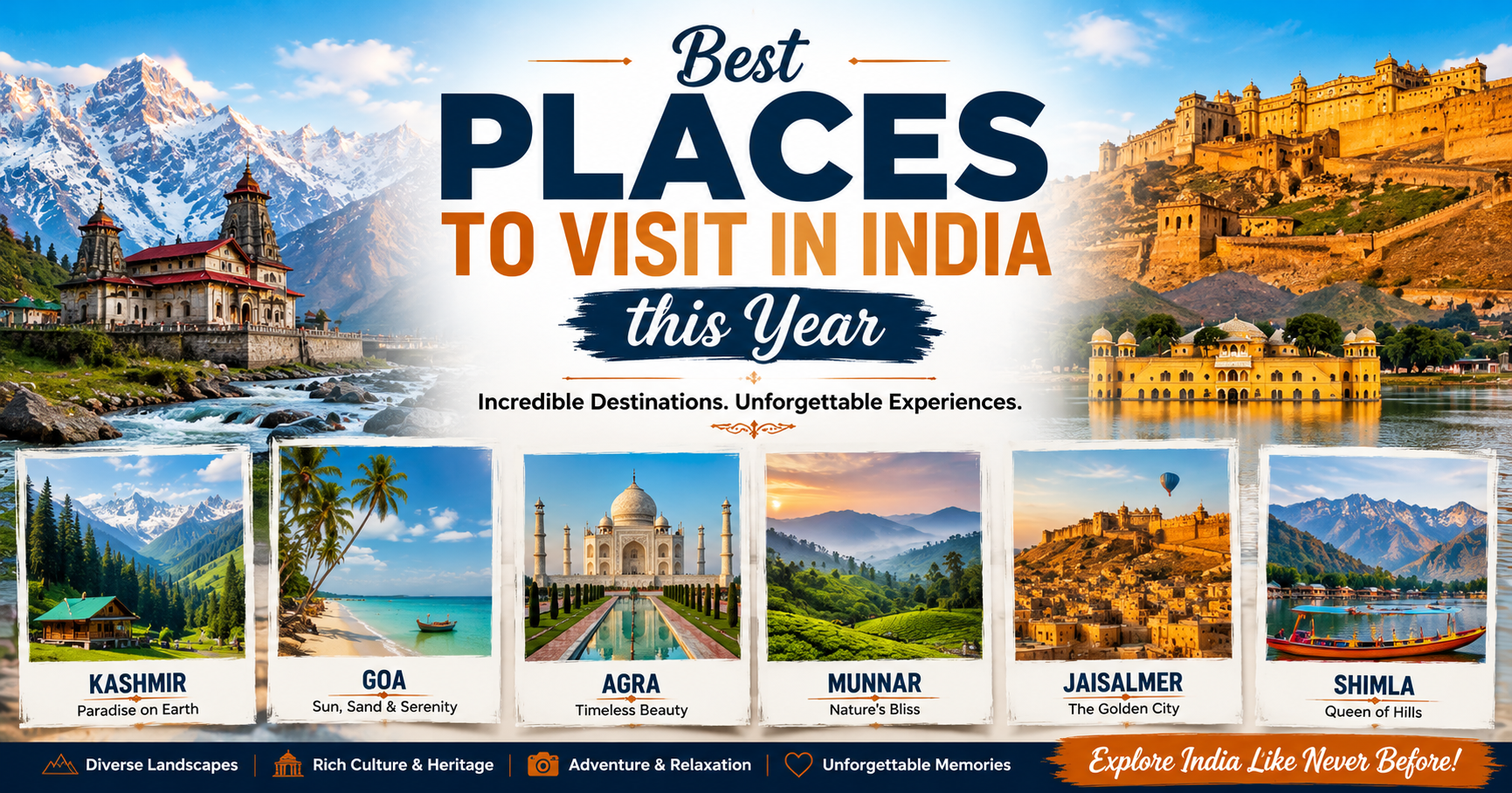
India’s 15 best destinations span palaces, beaches, mountains, and wildlife parks. Top picks include the Taj Mahal in Agra, the lake palaces of Udaipur, Goa’s beaches, the backwaters of Kerala, alpine Kashmir, high-altitude Ladakh, and the cosmopolitan cities of Delhi and Mumbai.
Few countries reward curiosity quite like India. As longtime tour operator Mohd Shafi Billo puts it, “If you visit India, you feel you have visited several countries, as every part is different.” That variety is exactly what makes planning a trip so tricky—and so exciting.
To save you from analysis paralysis, we’ve pulled together 15 standout destinations recommended by travel experts. Some are bucket-list icons. Others are quieter gems that fly under most tourists’ radar. Together, they showcase the forts, mausoleums, beaches, backwaters, and mountains that make this country unforgettable.
Whether you’re a first-timer chasing famous landmarks or a return visitor hunting for something new, this guide will help you decide where to go.
1. Taj Mahal, Agra, Uttar Pradesh
The 17th-century Taj Mahal tops most travelers’ India wish lists, and for good reason. This white marble mausoleum is the country’s most recognizable structure and one of the New Seven Wonders of the World.
It also comes with a love story. Emperor Shah Jahan built it in memory of his wife, Mumtaz Mahal, and both remain interred there today. “This iconic symbol of love is renowned for its architectural beauty, intricate marble work, and the captivating story behind its creation,” says Billo. For unobstructed views of the landmark, book a stay at The Oberoi Amarvilas.
2. Gujarat
If crowds aren’t your thing, head to Gujarat. This western state stays under the radar yet rewards visitors with festivals, textiles, and architectural heritage. “Under-explored but culturally rich, this state in India is a tapestry of festivals, textiles, architectural heritage, communities, and landscape,” says Shoba Rudra, founder and partner at hospitality consultancy Rare India.
Gujarat was also the birthplace of Mahatma Gandhi, who led the famous Salt March through the state in 1930. Stop by the National Salt Satyagraha Memorial, then explore the Kutch district, known for its distinctive metal bells that now sell as decorative wind chimes.
3. Udaipur, Rajasthan
Nicknamed the City of Lakes (there are at least seven), Udaipur feels like something out of a fairy tale. Its magnificent City Palace is actually an 11-palace complex housing a royal residence, hotels, and a sprawling museum.
A short boat ride across Lake Pichola brings you to the 18th-century Taj Lake Palace, now a luxury hotel that seems to float on the water. For another splurge-worthy stay, The Oberoi Udaivilas offers onion-domed cupolas and a moat-like pool that connects directly to some rooms.
4. Goa
Goa is India’s beach capital, where lazy days of swimming melt into late nights on the sand. The state has been a hippie haven since the 1960s, but it now draws families and couples looking for sun without the party scene.
History buffs will find plenty here too, thanks to seaside forts and UNESCO-recognized churches built during Portuguese rule. The food alone is worth the trip—Goan cuisine blends Konkani ingredients with fiery Portuguese influences.
5. Rishikesh, Uttarakhand
Set on the banks of the sacred Ganges River, Rishikesh has drawn spiritual travelers for generations. It bills itself as the “yoga capital of the world,” with ashrams that cater to Hindu pilgrims and yoga centers that host teacher-training courses for international visitors.
Not into yoga? You’ll still find plenty to do. Visit the ruins of the Maharishi Mahesh Yogi’s ashram (nicknamed the Beatles Ashram), or sign up for whitewater rafting on the Ganges. For a serious wellness reset, stay at nearby Ananda in the Himalayas.
6. Kerala
Stretching along India’s southern Malabar Coast, Kerala lures visitors with its marshy backwaters, best explored on an overnight houseboat. These cruises “showcase lush landscapes and peaceful villages, and give visitors a glimpse into local life,” says Billo.
There’s far more to the state than water, though. Head inland to the tea plantations of Munnar, with their cool climate and rolling green hills, or explore the historic port city of Kochi, known for both its coastal history and its contemporary art scene.
7. Kashmir
On the opposite end of the country from Kerala, Kashmir delivers entirely different—but equally stunning—scenery. With its alpine climate, evergreen forests, and snowy winters, the region is often compared to a mini Switzerland.
Srinagar sits at the heart of it all, famous for its elegant gardens and Dal Lake. “Highlights include staying on a houseboat or taking a shikara ride,” says Billo, who hails from the area. And don’t leave without trying wazwan, a lavish, meat-heavy feast that can stretch to three dozen dishes in a single sitting.
8. Ladakh
High on a plateau in India’s far north, Ladakh offers otherworldly landscapes dotted with stupas and monasteries. Most visitors arrive in the capital, Leh, during the short summer season, but the real magic lies beyond the city.
Billo recommends the Nubra Valley, reachable only by crossing Khardung La—one of the world’s highest motorable passes at 5,359 meters (17,582 feet). The valley charms travelers with monasteries, quiet villages, and apricot orchards. Keep an eye out for unusual wildlife too, from snow leopards to two-humped Bactrian camels.
9. Auroville, Tamil Nadu
For something completely different, head to Auroville in South India. This UNESCO-recognized township was founded in 1968 with the goal of “realizing human unity” beyond divisions of creed or nationality, and it’s home to residents from around the globe.
Most visitors come to see the golden, dome-shaped Matrimandir, the community’s spiritual center. But it’s worth lingering. As author and Auroville native Akash Kapur explains, “Come to Auroville if you’re interested in alternative societies, sustainable living, or spirituality… The community rewards sustained immersion.”
10. Andaman Islands
The crystalline waters most people associate with Thailand also wash up on India’s Andaman and Nicobar Islands. The big draw is Swaraj Dweep (also known as Havelock), home to Radhanagar Beach—more than a mile of white sand framed by jungle and clear water.
Getting there takes effort. You’ll fly to Port Blair on South Andaman Island, then catch a ferry for the final stretch. Worth noting: a few islands, including the secluded North Sentinel Island, are strictly off-limits.
11. Delhi
Many travelers treat India’s capital as a launchpad to other destinations, but Delhi deserves time of its own. This sprawling metropolis rarely slows down, whether you’re hunting for handicrafts in its markets or exploring Mughal history.
The city holds three UNESCO World Heritage sites: Humayun’s Tomb, Qutb Minar, and the Red Fort. For a calmer side of the capital, wander the trees and 15th-century tombs of Lodi Gardens or step inside the serene Baháʼí Lotus Temple.
12. Jaipur, Rajasthan
The capital of Rajasthan and part of North India’s famous Golden Triangle (alongside Agra and Delhi), Jaipur is a dream for lovers of architecture and shopping. “The Pink City, as it’s nicknamed, offers a rich cultural heritage, stunning landmarks like Amber Fort, vibrant bazaars, and intricate handicrafts,” says Billo.
Most highlights sit inside the walled old city, a UNESCO World Heritage site. Don’t miss Jantar Mantar, a collection of oversized 18th-century astronomical instruments, or Hawa Mahal, the honeycomb-like Palace of the Winds.
13. Jodhpur, Rajasthan
Known as the Blue City for the cerulean buildings spreading through its old quarter, Jodhpur draws travelers eager to explore the mighty Mehrangarh Fort. It’s also home to Umaid Bhawan Palace, which famously hosted the wedding of Priyanka Chopra and Nick Jonas.
There’s more to the city than forts and palaces, though. “The area around the Toorji Ka Jhalra stepwell in the old city is fun to explore,” says Sapna Bhatia, founder of Kaner Retreat and a local native. Nature lovers should check out the Rao Jodha Desert Rock Park near the fort.
14. Kaziranga National Park, Assam
In the northeast state of Assam, Kaziranga National Park is a paradise for wildlife enthusiasts. This UNESCO-listed refuge holds the largest population of Indian one-horned rhinoceroses on the planet—around 2,613 as of the 2022 census.
Rhinos may be the headline act, but they share the park with tigers, elephants, gibbons, sloth bears, and even a small number of endangered Ganges River dolphins. A safari here puts you face-to-face with some of Asia’s rarest animals.
15. Mumbai
Historic, glitzy, and enormous, Mumbai (formerly Bombay) ranks among India’s most cosmopolitan cities. It’s the nation’s financial and entertainment hub, and you can pack a lot of sightseeing into very little time.
Take a boat to Elephanta Island for its rock-hewn cave temples, admire the Indo-Saracenic architecture at Chhatrapati Shivaji Terminus, or watch thousands of garments dry at Dhobi Ghat, the world’s largest open-air laundry. Then unwind in Bandra West, home to many of the city’s best restaurants and hotels.
Start Planning Your India Adventure
India isn’t a country you can tick off in a single trip. From the marble symmetry of the Taj Mahal to the snowy peaks of Kashmir and the rhino-filled grasslands of Kaziranga, each destination offers its own distinct world.
The smartest move? Pick a region that matches your travel style, then go deep rather than wide. Beach lovers should aim for Goa or the Andamans. Culture seekers will thrive in Rajasthan’s palace cities. Adventurers belong in Ladakh or Rishikesh. Wherever you land, give yourself enough time to slow down and soak it in.
Ready to map out your route? Bookmark this guide, choose your top three destinations, and start booking before peak season fills up.
Frequently Asked Questions
What is the best time of year to visit India?
The ideal window for most of India is October through March, when the weather is cooler and drier. Hill stations like Ladakh and Kashmir are best in summer (May to September), since high-altitude passes such as Khardung La are often snowbound in winter.
Which places in India are best for first-time visitors?
First-timers usually start with the Golden Triangle—Delhi, Agra (for the Taj Mahal), and Jaipur. This route packs in iconic landmarks, rich history, and easy transport links, making it a manageable introduction to the country.
Where should I go in India for a beach vacation?
Goa is India’s most popular beach destination, offering everything from lively nightlife to quiet family-friendly shores. For something more remote, head to the Andaman Islands, where Radhanagar Beach delivers white sand and clear waters with far fewer crowds.
What are the best wildlife destinations in India?
Kaziranga National Park in Assam is the top choice for spotting Indian one-horned rhinoceroses, with around 2,613 recorded in the 2022 census. The park is also home to tigers, elephants, and rare Ganges River dolphins.
How many days do you need to explore India?
It depends on your itinerary, but two weeks lets you cover one or two regions comfortably—say, the Golden Triangle plus Rajasthan, or Kerala plus Goa. Trying to see the whole country in a single trip will leave you exhausted, so it’s better to focus.