
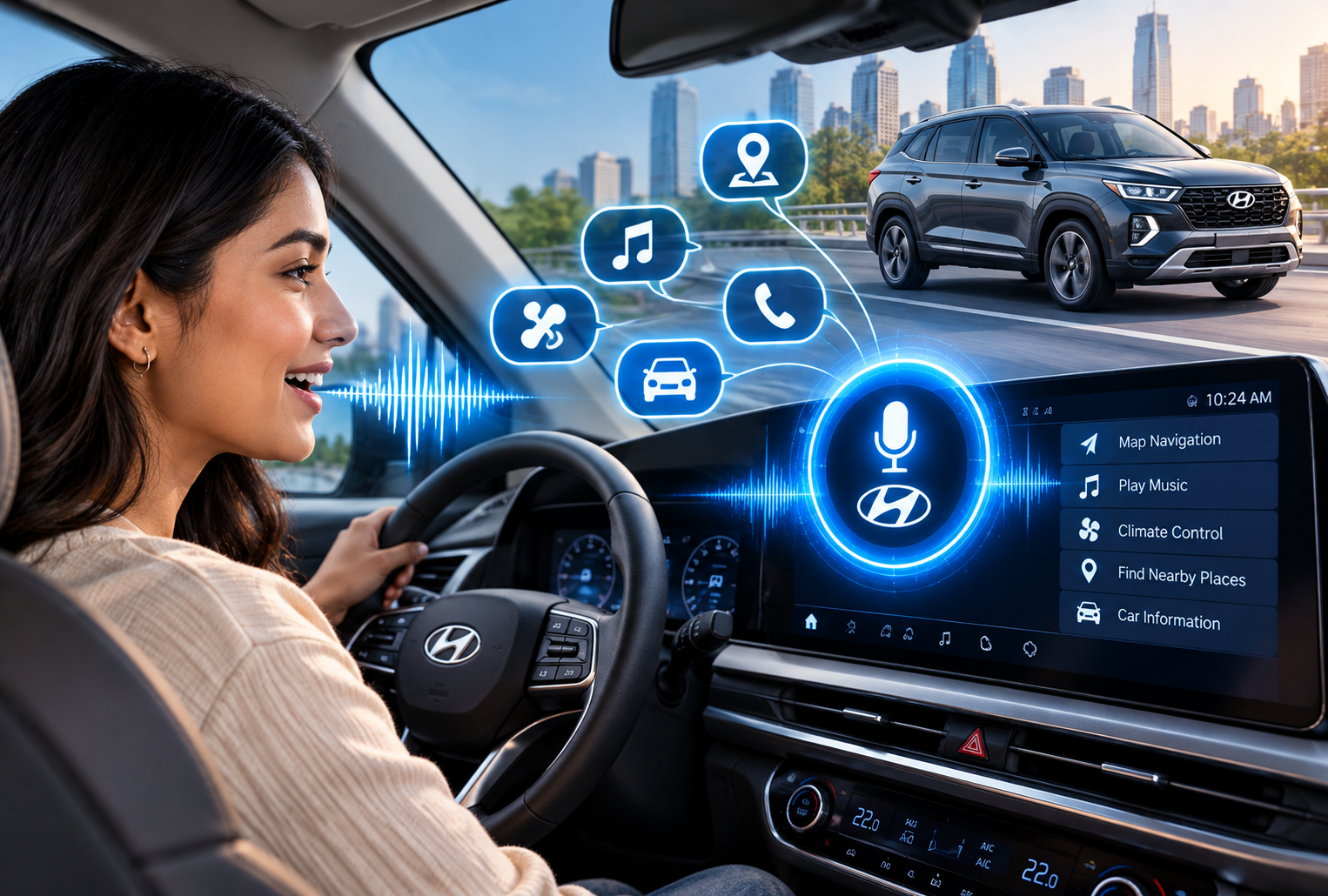
Introduction: AI Is Becoming Part of the Driving Experience
Artificial intelligence is changing how people interact with technology, and the automotive industry is beginning to bring these capabilities directly into vehicles. Instead of relying only on traditional voice commands and fixed infotainment menus, newer systems aim to understand natural language, respond to questions and provide more personalised assistance.
Hyundai Motor India has introduced this direction through its upcoming Hyundai BAYON, which features a generative AI voice assistant incorporating technology from Perplexity and voice AI capabilities powered by SoundHound AI.
According to Hyundai's official announcement, the India-spec BAYON is scheduled for launch on October 26, 2026. Its technology package includes a connected cockpit, dual curved displays and over-the-air software update capabilities.
The development highlights a wider shift: cars are increasingly becoming connected digital platforms, rather than machines with only basic infotainment systems.
What Is Hyundai's Perplexity-Powered AI Assistant?
A conventional in-car voice assistant generally responds to a defined set of commands, such as making a call, changing the music or selecting a navigation destination. A generative AI assistant aims to make these interactions more conversational.
Perplexity is known for its AI-powered answer and information-search technology. In Hyundai's announced system, Perplexity provides the intelligence component, while SoundHound AI supplies voice AI technology. The aim is to allow drivers to interact with the vehicle using more natural language.
For example, a driver may want information about a destination, ask a general question or request help with a travel-related task. The value of such a system depends on which functions Hyundai enables, the availability of an internet connection and the accuracy of the responses.
It is important to distinguish between announced capabilities and assumptions. Not every function available in a smartphone AI application will necessarily be supported inside a vehicle. Hyundai's final production specifications and regional feature availability should be checked before making a purchase decision.
How Could Generative AI Improve the Driving Experience?
1. More Natural Voice Conversations
Traditional voice assistants often require specific wording. A generative AI system can be designed to understand a wider range of natural-language requests.
This may make the system easier to use for people who do not remember exact voice commands. However, drivers should still keep their attention on the road and avoid lengthy conversations that could become distracting.
2. Information and Travel Assistance
AI-powered information systems can help users ask questions in a conversational way. When integrated with supported vehicle services, they may provide information relevant to a journey.
The precise answers available will depend on the system's internet access, software design and integration with navigation or connected services. Drivers should not rely on an AI response as the sole source for safety-critical information, road closures or emergency decisions.
3. A More Connected Cockpit
Hyundai says the BAYON uses its Connected Car Navigation Cockpit, or ccNC, accelerated by NVIDIA technology. The announced package includes two 12.3-inch curved displays and more than 70 Hyundai Bluelink connected features.
These systems bring vehicle information, navigation, entertainment and connected services into a more integrated interface. A well-designed cockpit can make information easier to access, although the actual user experience will depend on software responsiveness and interface design.
What Are Over-the-Air Updates?
Another important feature of modern connected cars is over-the-air software updating. Instead of requiring every software improvement to be installed during a dealership visit, compatible vehicle systems can receive supported updates remotely.
Hyundai's announcement says the BAYON supports over-the-air updates for up to 19 controllers. This can help the manufacturer maintain or improve supported vehicle software after delivery.
However, an over-the-air update does not mean every mechanical component can be upgraded remotely. The types of updates available depend on the vehicle's hardware, software architecture and manufacturer policies. Some repairs and changes will still require a workshop.
What Does This Mean for Car Buyers in India?
For Indian buyers, AI-powered features could make vehicle interaction more convenient, particularly as connected-car technology becomes more common. Natural voice interaction may be useful when drivers need to access supported functions without navigating multiple menus.
Nevertheless, buyers should consider practical factors alongside technology. Important questions include whether the assistant understands their preferred language, whether connected features require a paid subscription, how much mobile data is needed and whether services remain available in areas with weak connectivity.
It is also worth checking how the system handles privacy. Connected vehicles may process voice requests, location data and information about vehicle use. Buyers should review the manufacturer's privacy policy and understand which services collect data.
Potential Limitations and Safety Considerations
Generative AI systems can produce incorrect or incomplete responses. An answer that sounds confident is not necessarily accurate, and an in-car assistant should not replace the driver's judgement.
Voice interaction can reduce the need to look at a screen, but it can also introduce cognitive distraction. Drivers should avoid using complicated features while navigating heavy traffic or handling difficult road conditions.
Connectivity is another consideration. Some functions may work differently when mobile networks are unavailable. Buyers should test important features during a demonstration and ask the dealer which functions work offline.
The Future of AI-Powered Cars
The automotive industry is moving towards vehicles that combine software, sensors, connected services and AI-powered interfaces. These developments may eventually support more personalised assistance, better integration with digital services and simpler access to vehicle functions.
Hyundai's Perplexity-powered system is one example of this direction. Its real-world value will depend on reliability, regional support, software updates and how well the technology fits everyday driving.
Conclusion: Hyundai's announced AI voice assistant signals a new phase in connected-car technology. The combination of conversational AI, SoundHound voice technology, ccNC displays and remote updates could make the driving experience more intuitive. Buyers should still verify the final production features and evaluate safety, privacy and connectivity before choosing a vehicle.