OpenAI GPT-5.5 vs Anthropic Claude Opus 4.7: Which AI Model Wins in 2026?

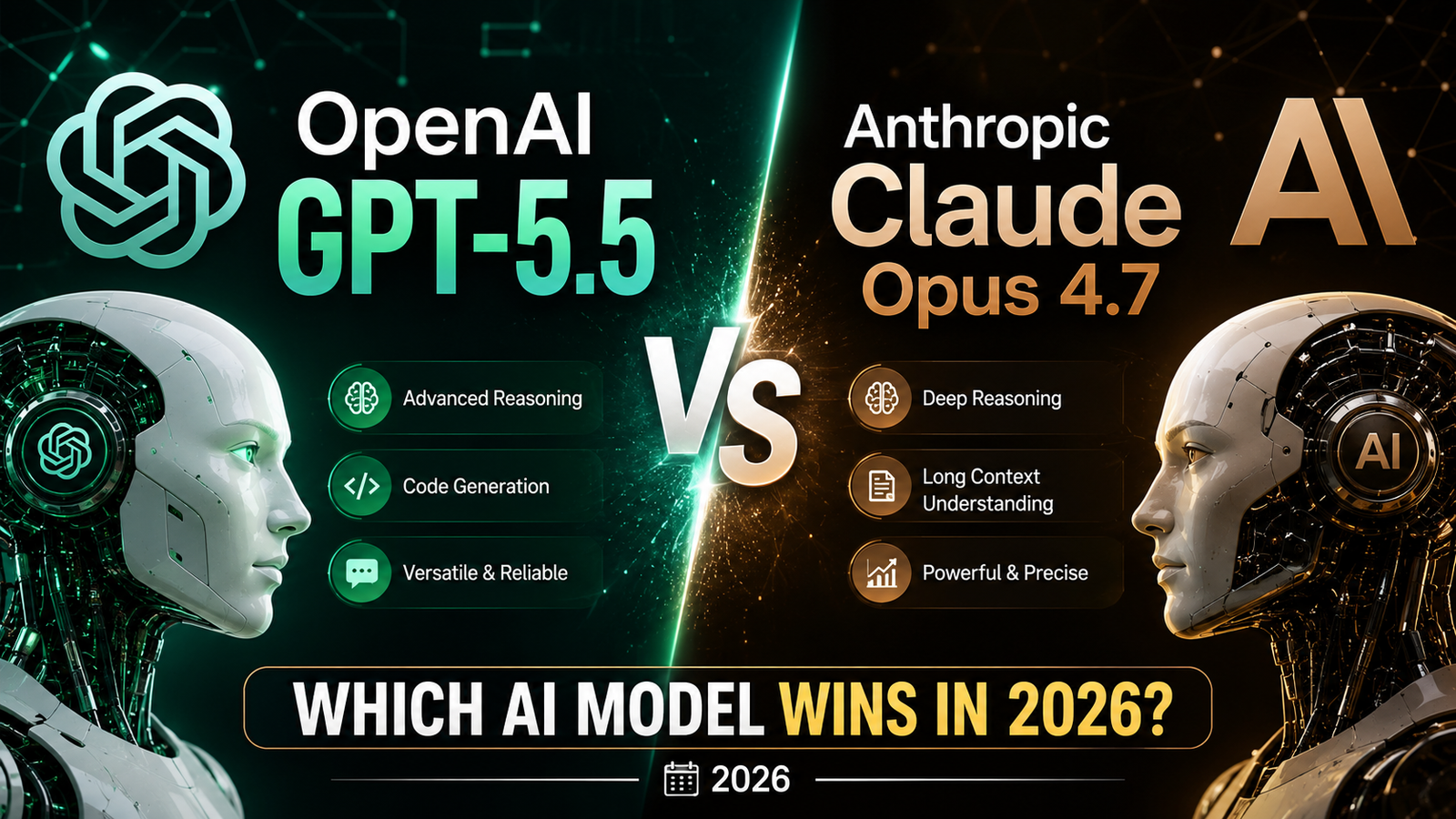
Artificial intelligence moves fast, and the race for dominance has never been closer. We now have two undisputed heavyweights battling for the top spot. OpenAI’s GPT-5.5 and Anthropic’s Claude Opus 4.7 both promise human-level reasoning, massive context windows, and flawless execution. But when you need to get real work done, which one should you choose?
Choosing the right AI can make a massive difference in your daily productivity. Whether you write marketing copy, build complex software, or analyse dense research papers, you need a tool that understands your specific needs. Both models pack incredible power, but they shine in completely different areas.
This guide breaks down exactly how these two powerhouse models compare. We will look at their performance across writing, coding, and research tasks. By the end, you will know exactly how to answer the big question: GPT-5.5 vs Claude Opus 4.7: Which AI Model Is Better?
The 2026 AI Landscape: A Brief Overview
Before we dive into specific tasks, we need to understand what makes these models special. OpenAI and Anthropic took very different paths to reach this point. Their underlying philosophies directly impact how their models behave and respond to your prompts.
GPT-5.5 represents OpenAI’s push toward aggressive reasoning and dynamic problem-solving. It acts like an energetic brainstorming partner that wants to give you the answer as quickly as possible. The model uses an advanced dynamic processing system, meaning it scales its computing power based on the complexity of your request.
Claude Opus 4.7, on the other hand, builds on Anthropic’s commitment to safety, nuance, and structural perfection. It acts more like a meticulous senior editor or principal engineer. Opus 4.7 takes a moment to map out its responses logically, ensuring every output aligns perfectly with your constraints and instructions.
Writing Performance: Creativity vs. Coherence
Writing remains one of the most common reasons people use AI. However, creating a catchy tweet requires a very different skill set than writing a 50-page technical manual. Let us see how both models handle the written word.
GPT-5.5 for Writing Tasks
GPT-5.5 excels at creative bursts and matching specific brand voices. When you need punchy marketing copy, engaging social media posts, or creative storytelling, this model delivers exceptional results. It adapts to tone adjustments instantly and rarely sounds robotic.
The model also features an incredible ability to brainstorm. If you suffer from writer’s block, GPT-5.5 will throw dozens of highly creative angles at you in seconds. It uses colloquialisms naturally and understands modern internet culture better than any previous iteration.
However, GPT-5.5 can sometimes lose track of complex formatting instructions in longer documents. If you ask it to write a 10,000-word ebook with very specific heading structures, it might deviate from your instructions around chapter four. It prioritises speed and flow over strict structural adherence.
Claude Opus 4.7 for Writing Tasks
Claude Opus 4.7 is the undisputed king of long-form, structured writing. When you need to draft comprehensive white papers, grant proposals, or legal summaries, Claude performs flawlessly. It never loses the thread of your argument, even after generating thousands of words.
Anthropic trained this model to follow instructions with rigid precision. If you tell Claude Opus 4.7 to avoid certain words, format every third paragraph a specific way, and maintain an academic tone, it will execute perfectly. It creates highly polished, professional content that requires very little editing.
The downside? Opus 4.7 can sometimes feel a bit dry or overly formal for casual content. You have to push it quite hard with your prompts to get it to write engaging, humorous, or punchy marketing copy. It prefers to play it safe and stay professional.
Coding Capabilities: Syntax and Problem Solving
Software development has changed forever thanks to AI assistance. Both models can write boilerplate code in seconds, but real development involves complex logic, debugging, and system architecture.
GPT-5.5 in Software Development
OpenAI gave GPT-5.5 massive upgrades in agentic workflows. This means the model does not just write a function; it tries to build the whole app. You can ask it to spin up a React frontend with a Node backend, and it will generate the necessary scripts and file structures seamlessly.
GPT-5.5 shines when you need quick solutions or when working with highly popular frameworks. It knows the latest libraries and can troubleshoot common errors with incredible speed. It acts like a brilliant junior developer who works at lightning speed.
Its main weakness in coding is its tendency to confidently suggest deprecated packages or rush through complex security implementations. You must review its code carefully when building enterprise-grade applications handling sensitive user data.
Claude Opus 4.7 in Software Development
Claude Opus 4.7 approaches coding with the mindset of a senior systems architect. It does not just write code; it explains why it chose a specific design pattern. It excels at refactoring large, messy codebases into clean, maintainable systems.
Because Opus 4.7 has a near-perfect recall across its massive context window, you can upload dozens of your project files. It will read them all, understand your existing architecture, and write new features that perfectly match your current coding standards. It catches edge cases and security vulnerabilities that other models miss.
While it might take slightly longer to generate a response than GPT-5.5, the code Claude produces usually compiles on the first try. It wastes less of your time on frustrating debugging sessions.
Research and Data Analysis
In 2026, we do not just ask AI for facts; we give it massive datasets and ask for deep insights. Research requires incredible accuracy, large context windows, and logical deduction.
Context Windows and Accuracy
Claude Opus 4.7 dominates the research category. Anthropic expanded its context window to handle the equivalent of several thick textbooks at once. You can upload financial reports, medical journals, and historical documents, and Claude will cross-reference them with perfect accuracy. It rarely hallucinates facts and will clearly tell you if a document lacks the information you requested.
GPT-5.5 is also highly capable, especially when connected to live web browsing. If you need real-time data or sentiment analysis on current events, GPT-5.5 pulls information faster and synthesises it beautifully. However, when processing heavy, static documents, it occasionally glosses over minor details that Claude would catch.
GPT-5.5 vs Claude Opus 4.7: Which AI Model Is Better?
So, GPT-5.5 vs Claude Opus 4.7: Which AI Model Is Better? The answer entirely depends on your daily workflow. Neither model completely replaces the other, as they serve different primary functions.
You should choose GPT-5.5 if you prioritise speed, creativity, and dynamic brainstorming. It remains the top choice for marketers, copywriters, and developers who want fast prototypes. Its conversational abilities and cultural awareness make it incredibly fun and efficient to use.
You should choose Claude Opus 4.7 if you value precision, structure, and deep analysis. It is the essential tool for academics, lawyers, technical writers, and senior developers. When you cannot afford to make a mistake, Claude is the model you want reviewing your work.
Conclusion and Final Verdict
The rivalry between OpenAI and Anthropic has given us two spectacular tools. GPT-5.5 brings unmatched creative energy and speed to the table. Meanwhile, Claude Opus 4.7 offers a level of logical precision and reliability that professionals demand.
To get the most out of these tools, audit your own workflow. Do you spend more time brainstorming and drafting quick content? Subscribe to GPT-5.5. Do you spend hours analysing data, structuring long documents, or reviewing complex code? Claude Opus 4.7 will save you more time.
Many top professionals in 2026 actually use both. They use GPT-5.5 to brainstorm ideas and generate initial drafts, then run everything through Claude Opus 4.7 for final polish and logical review. Evaluate your tasks for the week ahead, pick the model that fits your needs, and start building.
Also, read this page: Why Internxt is the Top Privacy-Focused Cloud Storage in 2026